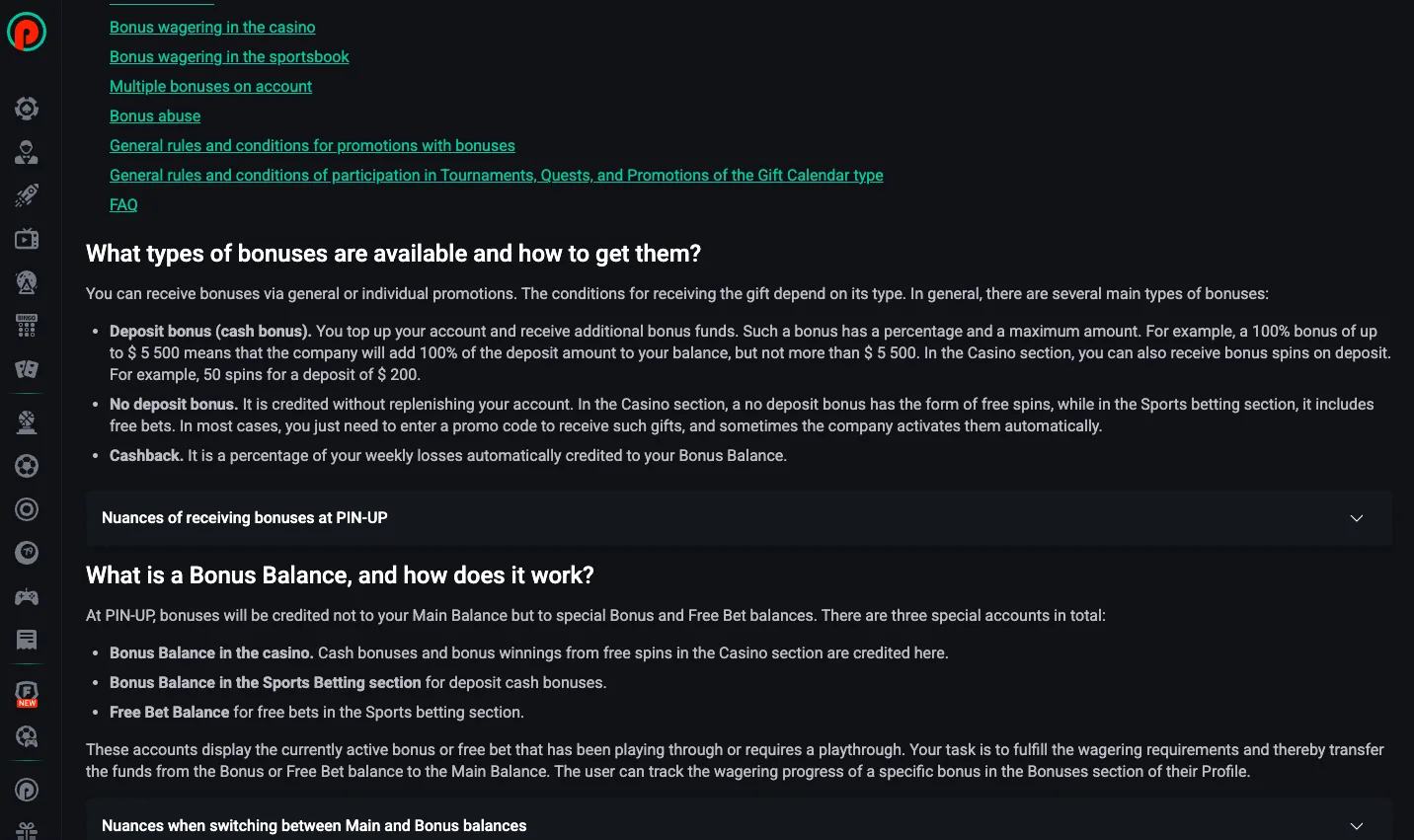
Screenshot context: real Pin Up bonus/promo screen used for the twelve bonuses six months guide, tying the bonus rules to the product UI.
Period covered: September 2025 to February 2026
12 clearances: 9 casino, 2 sport, 1 free spins. This post separates variance from process errors and shows which bonus class remained consistently actionable.
Methodology and Confidence
All sessions logged with timestamp, wager target, and end balance.
Net result measured against no-bonus baseline and against raw deposits.
Outliers tagged where rule violations or unusual variance occurred.
Results by Bonus Type
Bonus Type
Count
Net Result
Win / Loss / Flat
Operational Risk
Casino 50x
9
-€94
4 / 3 / 2
High (time + max-bet sensitivity)
Sport 10x
2
+€110
2 / 0 / 0
Medium (selection filtering)
Free spins
1
+€11
1 / 0 / 0
High (24h deadline)
Main Lessons
Sport bonuses delivered stronger consistency per hour invested. Casino bonuses were manageable but fragile when discipline slipped. A single voided run removed roughly 40% of accumulated positive variance, so procedural controls mattered more than small RTP optimizations.
Small wagering-rule changes often look trivial until they break a working routine. A move from 1.4 to 1.6 minimum odds, or a small shift in progress-tracker behavior, changes which slips qualify and how long bonus clearance takes in practice. That is why these update posts exist separately from the evergreen guides: the main pages explain the stable mechanics, while these notes capture the moments when a once-correct habit stops being correct.
Readers should use this page in combination with the evergreen calculators and worked examples. If your ticket or session still behaves differently after following the rule described here, compare against worked examples and the relevant main bonus page before escalating. A short dated post should help you identify whether the issue is a genuine rule change, an execution error, or simple variance.
Evidence Goal for Final Publish State
The final screenshots should make the rule boundary or tracker behavior undeniable: before/after terms, qualifying vs non-qualifying slip examples, or progress-counter states. Once those are in place, the post becomes a much stronger ranking asset for change-alert queries.
How This Page Supports the Main Site
This page is intentionally narrower than the main guides around it. Its job is to document one dated signal, one tested scenario, or one specific operational change in a way that the evergreen overview pages should not. That makes it useful for readers who arrive with a freshness query and useful for the wider site architecture because it gives the core pages a credible, linkable support asset instead of forcing every new event into the homepage or FAQ.
If your own experience differs from what this page describes, that difference is worth investigating rather than ignoring. Either the pattern changed after this page was published, or your account/method/provider mix is behaving differently enough to deserve its own note. In both cases, the right next step is to compare this page with the evergreen guide it supports and use the final screenshot pack to document the gap clearly.
Source and Safety Note
This page is an editorial Pin-Up guide, not a promise of winnings, account approval, or payment speed. For broader player-safety context, see GambleAware safer gambling guidance. Keep sessions budgeted and use the Registration link only where online gambling is legal for you.
How to Use This Report Without Overreading It
This page is a focused support note for How I Cleared 12 Pin Up Bonuses in 6 Months, not a promise that every account will see the same result. The useful part is the pattern: what was checked, which conditions were present, and which next page a reader should use after comparing the result with their own account. For this topic, the most important review fields are rule text, contribution rate, max-bet limit, eligible games, time window, and clearance progress. If one of those inputs changes, the practical recommendation can change as well.
The safest way to read any bonus wagering behavior update is to separate a platform-side signal from a user-side signal. A platform-side signal means the same behavior appears across multiple accounts, devices, or sessions. A user-side signal may come from one bank, one carrier, one browser, one bonus state, or one KYC profile. This distinction matters because platform-side issues justify changing the main recommendation, while user-side issues usually call for a troubleshooting step or a fallback path.
Before acting on this note, compare it with the evergreen guide linked from this page and check the live cashier, lobby, or account screen yourself. Treat dated observations as a freshness layer on top of the main guide, not as a replacement for current on-screen terms. When the live screen disagrees with this report, the live screen wins; the report remains useful because it explains what changed and which evidence to collect if support needs to review the case.
Editorial Verification Standard
Screen state: the page should be checked against the current Pin Up screen or game/client state before a recommendation is reused.
Timing: dated observations should include the review window and avoid pretending to be live telemetry.
Limitations: sample size, account region, device, currency, and payment method can all change the outcome.
Reader action: every report should point to the next practical step rather than ending with a vague conclusion.