
Responsible Gambling Resources

From the other side of the counter, I saw the same pattern play out over and over. A player claims a bonus. The wagering requirement pushes them to keep playing past the point they'd have normally stopped. Variance goes negative. They think they need to "get back to even" before the clock runs out. They deposit more. They lose more. They chase. A process that started with a friendly €100 deposit ends with €400 of losses and a sense that the system was rigged against them.
The system wasn't rigged. They were running the math the wrong way. But the experience of losing while chasing a wagering deadline is indistinguishable from being cheated, and it's a common path into problem gambling. If any part of that description feels familiar, the resources on this page are for you.
Signs You May Have a Gambling Problem
Problem gambling rarely announces itself. It creeps up as a set of small shifts in behavior that accumulate until one day you realize you've crossed a line you didn't mean to cross.
Behavioral Signs
- Playing longer than you planned, most sessions
- Chasing losses — increasing bet sizes after losing streaks to "get back to even"
- Depositing mid-clearance to extend a session rather than accepting the outcome
- Hiding gambling activity from partners or family
- Thinking about the next session during work, meals, or sleep
- Feeling irritable or anxious when you can't play
- Repeatedly trying to cut back and failing
Financial Signs
- Depositing money earmarked for rent, food, or bills
- Borrowing money to gamble (credit cards, personal loans, family)
- Depleting savings to fund play
- Missing payments on other obligations
- Selling possessions or taking cash advances to deposit
- Hiding credit card statements or bank alerts
Any single item doesn't mean you have a problem. Several items together, or a pattern that's getting worse over time, does. Use Pin Up's built-in deposit limits before the pattern hardens — they're designed to give you a brake to pull.
Self-Exclusion Options on Pin Up
How to Request Self-Exclusion
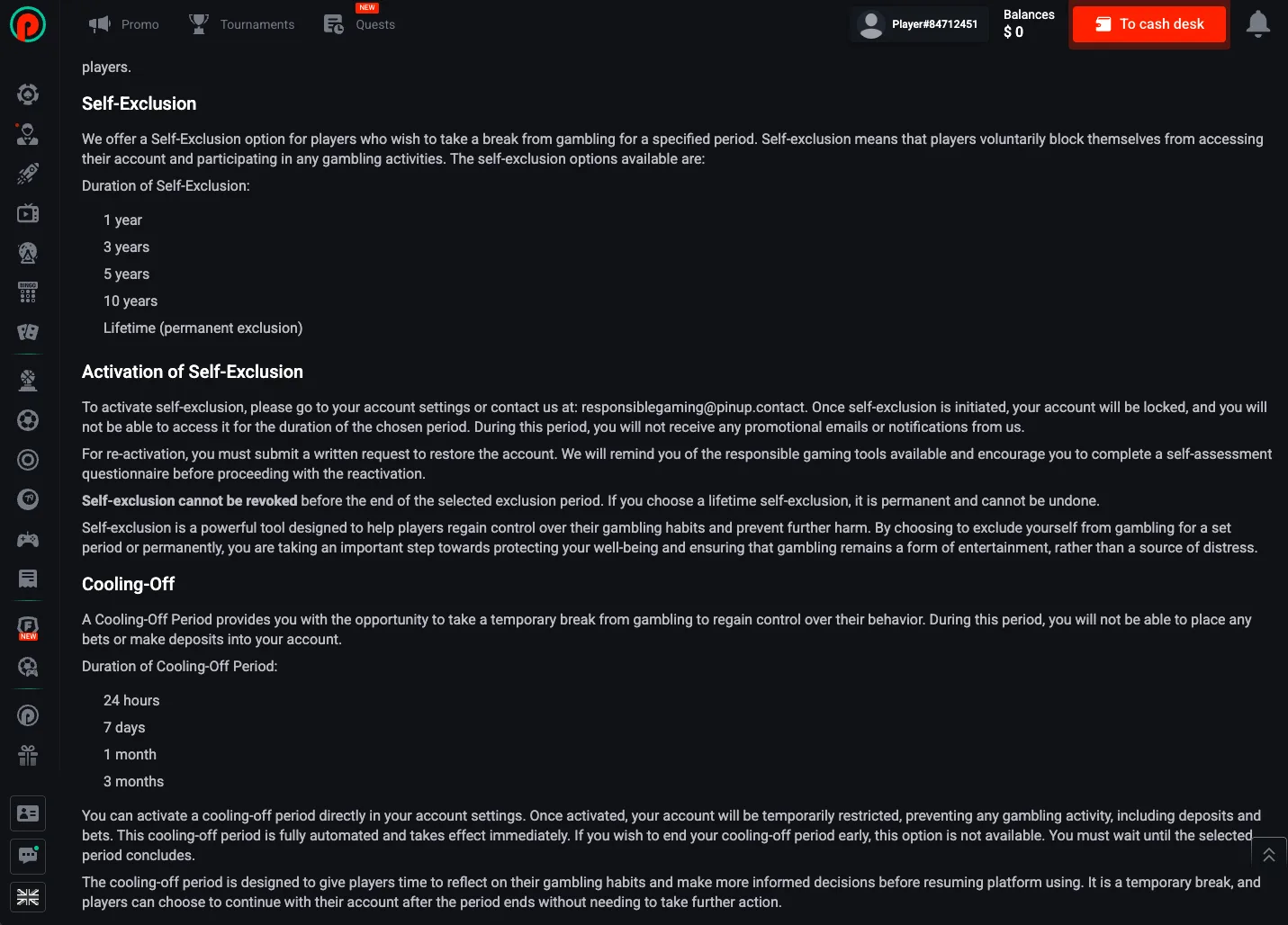
Log into Pin Up. Account Settings → Responsible Gambling → Self-Exclusion. Pin Up offers cooling-off periods (24 hours, 7 days, 30 days) and longer exclusions (6 months, 1 year, permanent). Select the duration, confirm with your account password, and the exclusion applies immediately. You won't be able to log back in or place any bets until the exclusion period ends. Bonus wagering counters freeze while excluded — but if you return after the exclusion and haven't cleared the bonus, the original clock has usually expired so the bonus is gone.
Permanent exclusion is permanent. Pin Up will not reverse it even if you ask. That's the whole point of the feature.
Cool-Off Periods
Cool-off periods are for when you feel like things are going sideways but you don't want to commit to long-term exclusion. 24 hours is enough to interrupt most tilt patterns. 7 days is enough to let a variance-driven bad session fade from memory. 30 days is a meaningful reset.
Helplines and Support Services
Global — BeGambleAware
BeGambleAware.org — UK-based, globally accessible. Free confidential support. UK phone 0808 8020 133. Online chat and self-assessment tools. One of the most thorough English-language resources.
Global — GamCare
GamCare.org.uk — structured treatment programs, peer support, and family resources for people affected by someone else's gambling. Live chat 24/7.
India — iCall
iCall — Tata Institute of Social Sciences psychological helpline. Free email and phone in English, Hindi, and several regional languages. Phone +91 9152987821.
Brazil — Jogadores Anônimos
The Brazilian chapter of Gamblers Anonymous. Free peer-support meetings in major cities plus online groups. Search "Jogadores Anônimos" plus your city for local chapter info.
Russia — Gambling Therapy
Gambling Therapy — international online support with Russian-language moderators.
Setting Deposit and Loss Limits
Pin Up lets you set daily, weekly, and monthly deposit limits. Set them before your first deposit — it's easier to set a limit when you're calm than after a losing session. Account Settings → Responsible Gambling → Deposit Limit. Decreases take effect immediately. Increases have a mandatory 48-hour cooling-off period before they take effect — a deliberate brake against impulse increases during tilt.
Starting benchmark for deposit limits: no more than 1% of your gross monthly income as a monthly Pin Up limit. That's "entertainment budget" territory. Money you can afford to lose without affecting anything else in your life. If you find yourself hitting the monthly limit and wanting to raise it, that's a signal worth respecting.
Time-Out and Cooling-Off Periods
Beyond deposit limits, Pin Up supports session time limits and periodic reality-check reminders. A session time limit auto-logs you out after a set duration. A reality check pops up every X minutes showing your session balance and how long you've been playing — useful for breaking time-dissociation on long slot sessions.
The reality check is particularly useful during bonus clearance runs because clearance sessions are long by definition (2–3 hours) and autoplay makes time disappear. Set the reality check to every 30 minutes and you get a natural moment to check your wagering counter, confirm you're under the max-bet cap, and decide whether to keep going.
Why wagering pages need stricter boundaries than normal casino pages
Wagering requirements create a special kind of pressure because they turn gambling into a task. Once a player starts thinking “I have already done 70% of the rollover, I cannot stop now,” the session stops feeling like entertainment and starts feeling like sunk-cost recovery. That shift is one of the most dangerous states in bonus play. It makes bad sessions feel mandatory.
The healthier frame is this: a bonus is optional from the first second to the last. If the clearing run starts demanding more money, more time, or more emotional energy than you planned, quitting the rollover is a rational decision. Losing the bonus is often cheaper than preserving it. People in trouble do not usually need more calculator accuracy at that moment. They need permission to stop.
How Pin Up's RG Tools Work
Pin Up's responsible gambling tools are implemented at the platform level, so they apply regardless of how you log in. Deposit limits persist across sessions and withdrawals don't reset them. Self-exclusion survives logout and applies to every future login attempt until the period ends. The tools aren't perfect — they only cover the Pin Up account they're attached to, not your activity on other operators.
Curacao doesn't currently run a central cross-operator self-exclusion registry for its licensees, which is a genuine gap in the Curacao framework. If you need cross-operator enforcement and you're in a country with a central registry (GAMSTOP in UK, OASIS in Germany, Spelpaus in Sweden), use the central registry on top of Pin Up's individual controls. That's the only way to get hard enforcement across every operator you might be tempted to use.
One more thing: wagering requirements can be a psychological trap. The 72-hour clock creates urgency that pushes players to keep going even when variance is bad. If your bonus clearance starts feeling like a job you can't quit, stop. Take the hit on the bonus. The €120 you forfeit is cheaper than the €400 you'll lose chasing it.
If you choose to play, do so responsibly — open Pin Up safely